 Store
StoreDay Without Art



An international day of action and mourning in response to the ongoing AIDS crisis on December 1 / World AIDS Day
Visual AIDS organized the first Day Without Art on December 1, 1989, mobilizing museums and arts organizations across the United States for a collective day of mourning and action in response to the AIDS crisis.
Over more than three decades, Day Without Art has continually adapted to the changing realities of the AIDS crisis. What began with museums closing or removing artwork as a symbolic gesture of loss evolved into a platform for producing and presenting art about HIV/AIDS. In 1997, Day Without Art became Day With(out) Art, marking a growing emphasis on the presence and work of artists living with HIV at a time when the epidemic was increasingly treated as a thing of the past.
Day With(out) Art has since taken many forms—including public art, television broadcasts, printed matter, exhibitions, web projects, films, and public programs—while continuing to use the collective reach of cultural institutions to keep HIV/AIDS visible.
Since 2014, Visual AIDS has commissioned short videos by artists and filmmakers for Day With(out) Art, distributing an annual program through a network of more than 150 museums, galleries, universities, AIDS organizations, and other institutions worldwide. These projects address urgent and contemporary dimensions of HIV/AIDS while continuing Day With(out) Art’s longstanding commitment to using art to insist that AIDS is not over. View the complete archive of videos commissioned by Visual AIDS here.
How to Participate
For more information about how to participate in Day With(out) Art in your community, sign up for updates here or email Elena Guzman at eguzman@visualaids.org.
History of Day Without Art
In 1989, in response to the worsening AIDS crisis and coinciding with the World Health Organization’s second annual World AIDS Day on December 1, Visual AIDS organized the first Day Without Art.
A committee of art workers—curators, writers, artists, and other arts professionals—issued a call for a national day of “mourning and action in response to the AIDS crisis.” More than 800 museums, galleries, and arts organizations across the United States participated. Some closed their doors or darkened their galleries; others shrouded or removed artworks, replacing them with information about HIV and safer sex, or organized exhibitions, readings, memorials, rituals, and performances.
By coordinating these actions across hundreds of institutions, Visual AIDS used the absence of art to make the devastating impact of AIDS visible. The project also demonstrated the power of museums and cultural organizations acting collectively: institutions across the country used their public platforms to call attention to a crisis that government and media had failed to adequately address.
Initially conceived as a one-time action, Day Without Art became an annual event. By the early 1990s, thousands of organizations around the world were participating, and Visual AIDS increasingly worked with artists to produce and distribute public art projects responding to the epidemic. As the AIDS crisis changed, so did the forms, messages, and methods of Day Without Art.
In 1997, Day Without Art became Day With(out) Art, reflecting a shift from the symbolic removal of art toward the presentation of artwork and the visibility of artists living with HIV. In the decades since, the project has continued to evolve through print, public art, television, the internet, film, and video while maintaining the international network of artists, activists, and cultural institutions built through the original action.
Learn More
For a deeper history of Day With(out) Art and the artists, activists, and art workers who shaped it, see Absence/Presence: 30 Years of Day With(out) Art, the first publication to trace the project’s evolution from a collective act of mourning and refusal into an international platform for artistic responses to the ongoing AIDS crisis.
Order Absence/Presence: 30 Years of Day With(out) Art
For a firsthand critical perspective on this history, see AIDS, Art & the Origins of the Culture War: Selected Writings of Robert Atkins. A co-founder of Visual AIDS and an organizer of the first Day Without Art, Atkins documented the intersections of AIDS activism, censorship, queer culture, and the political battles transforming the art world in the 1980s and 1990s.
Order AIDS, Art & the Origins of the Culture War
Selected Projects
NIGHT WITHOUT LIGHT (1990–2001)
Night Without Light brought Day Without Art to the New York City skyline, darkening lights on skyscrapers, bridges, and public monuments for fifteen minutes on December 1. Repeated annually for more than a decade and replicated in cities across the country, the dramatic gesture of absence became an iconic image of Day Without Art.
MOMENT WITHOUT TELEVISION (1990–1992)
Moment Without Television brought the symbolic absence of Day Without Art into millions of homes. For sixty seconds on December 1, participating cable networks interrupted their programming and went black, asking viewers to reflect on lives lost to AIDS and what each person could do in response to the crisis. Twenty-three cable networks participated in 1990; by 1992, more than 50 networks were taking part.
POSITIVE ACTIONS (1990)
Positive Actions invited artists to propose public artworks that could “inform, move, inspire, and/or provoke” audiences around HIV and AIDS. Proposals were exhibited simultaneously at three New York City venues, and a 30-second animated PSA by Bing Lee and Garson Yu was selected for broadcast on television.
AIDS TIMELINE BY GROUP MATERIAL (1990)
For the second Day Without Art, Group Material transformed its landmark AIDS Timeline into a distributed print project published across eleven art magazines. By moving the work beyond the gallery and into widely circulating publications, the project used distribution itself as a strategy for communicating the complex social, political, and cultural history of AIDS.
EVERY TEN MINUTES (1991–1992)
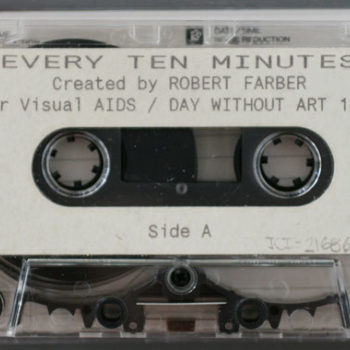
Created by artist Robert Farber, Every Ten Minutes was an audio artwork in which a bell tolled once every ten minutes—the rate at which people were dying of AIDS-related complications at the time. Recorded in the bell tower of Riverside Church, the work was distributed by Visual AIDS and played at museums and galleries across New York City for Day Without Art.
BROADSIDES (1992–1999)
Visual AIDS commissioned artists including Barbara Kruger, Glenn Ligon, John Giorno, and Adrian Kellard to create easily reproducible graphics communicating the social and political impact of AIDS. Printed in black and white, Xerox-ready, and free of copyright, the broadsides could be photocopied, enlarged, adapted, and distributed by participating organizations—allowing AIDS-related art and information to circulate far beyond the traditional art world.
MAPPING NO BOUNDARIES (1997)
More than 50 museums, galleries, arts nonprofits, and AIDS organizations across New York and New Jersey participated in Mapping No Boundaries, presenting work by artists living with HIV alongside exhibitions, educational programs, and workshops. The initiative reflected Day With(out) Art’s growing emphasis on the presence of artists living with HIV rather than the symbolic removal of art.
DAY WITH(OUT) ART ON THE WEB (1998–2000)
As the internet created new ways to build communities and distribute information, Day With(out) Art moved online. Creative Time commissioned artists to create banner ads and other web projects that circulated across a network of participating websites—a digital extension of the reproductive and distributive strategies behind Visual AIDS’s earlier broadsides.
Related Projects











Related Events
Narrow Rooms: The Passion According to G.H.B. |
June 19, 2026 |
Experiment as Method, Care as Practice: Four Decades of HIV/AIDS Film and Video |
June 4, 2026 |
Day With(out) Art: Asia Focus |
December 13, 2024 |
Day With(out) Art: Asia Focus |
November 28, 2024 |
Day With(out) Art: Asia Focus |
November 8–November 10, 2024 |
The Many Lives of Visual AIDS’s Day With(out) Art |
December 1–December 15, 2022 |