Alex Lenczycki will seek to illuminate the life and work of Gin Louie (1947-1994), a pivotal figure and former director of the Lower East Side Print Shop in the 1980s, with particular interest in his artistic transition to autobiographical assemblage following his AIDS diagnosis.
Chava Maeve Krivchenia will sort through Garland Eliason-French’s (1942-1996) correspondence, personal journals, photographs, art documentation, and ephemera, and plans to map the artist’s creative influences, with a particular focus on her time spent in Chicago and the Midwest.
Claudia Mattos's research proposes the first comprehensive art historical study of Craig Coleman's (1961-1994) Miami-era practice, utilizing community archives and oral histories to reconstruct his multidisciplinary work. The goal is to situate Coleman's fusion of visual art, writing, and performance within the city's queer cultural history and the legacy of AIDS-era expression in South Florida.
Diogene Artiles will look at the work of Miguel Ferrando (1957-1996), Dominican artist active in New York City’s downtown art scene during the 1980s and 1990s. Diogene is interested in Ferrando’s use of religious iconography, Dominican national symbols, and his artistic community and inspirations in New York City. |
Helena Shaskevich will research artist Michael Tidmus’s (1951-2012) HyperCard projects with a specific focus on his 1987 The AIDS Stack. Made just prior to the widespread use of the world wide web, the work is an early example of AIDS related computer activism.
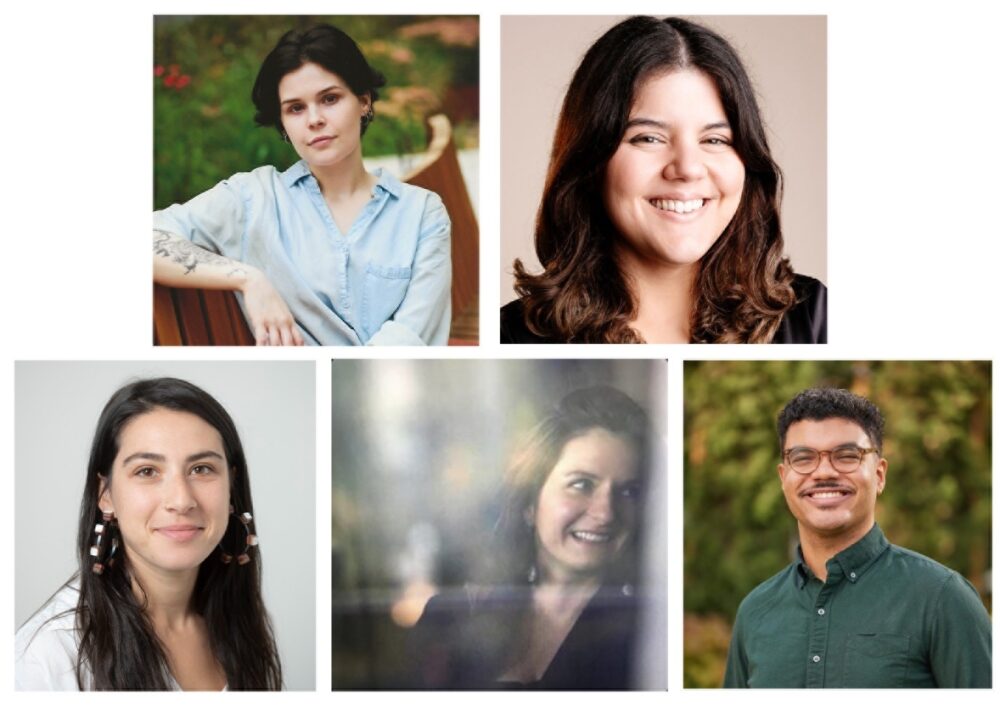
About the Fellows
Alex Lenczycki (they/them) is an art historian whose research engages with the work of various queer artists and community groups from the 1970s through the 1990s. Previous research projects include examining the use of artistic appropriation in AIDS education posters and print media of the 1980s, and interpreting installation and assemblage works through lenses of autobiography, queer death studies, and selfmemorialization. They have an MA in Art History from the Courtauld Institute of Art, London, and BAs in Anthropology and Art History from Southern Methodist University, TX.
Chava Maeve Krivchenia is a curator and writer. She currently serves as the Assistant Curator at the John Michael Kohler Arts Center in Sheboygan, WI. Krivchenia earned her MA in Contemporary and Modern Art History from the School of the Art Institute of Chicago (2020).
Claudia Mattos is a curator interested in contemporary art's engagements with emergent technologies and critical pedagogy. She is an Associate Curator at Rice University's Moody Center for the Arts. Previously, she has held curatorial positions at The Bass Museum of Art, The Baltimore Museum of Art, and other institutions.
Diogene Artiles is a Dominican-American writer from Brooklyn, New York. They studied Comparative Literature at Columbia University, where they researched the queer visual cultures of New York City and Rio de Janeiro. Diogene is interested in queer visual histories, queer existential literature, and the interplay between legal and LGBTQ+ studies. Diogene is returning from his Luce Scholar year in Bangkok, where he worked with Pribta-Tangerine, Bangkok’s LGBT clinic. They are now working on an independent writing project, so you can catch them drafting in their legal pads and rereading Giovanni’s Room at a cafe near you. |
Helena Shaskevich is an assistant professor of modern and contemporary art history at Kennesaw State University, with a specialization in experimental media art from the 1960s to the present. Her scholarly writing has been published in numerous journals, including Feminist Media Histories, Camera Obscura, Art Journal, Woman’s Art Journal, Millennium Film Journal, and Afterimage, among others. Her short-form writing can be found in the Brooklyn Rail, Burlington Contemporary, and Burnaway.
 Store
Store