Store
StorePast Event
Experiment as Method, Care as Practice: Four Decades of HIV/AIDS Film and Video
e-flux Screening Room
Date:
Thursday, June 4, 2026 from 7:00pm–9:00pm
Price: General $10, Student $7
 Visual AIDS Event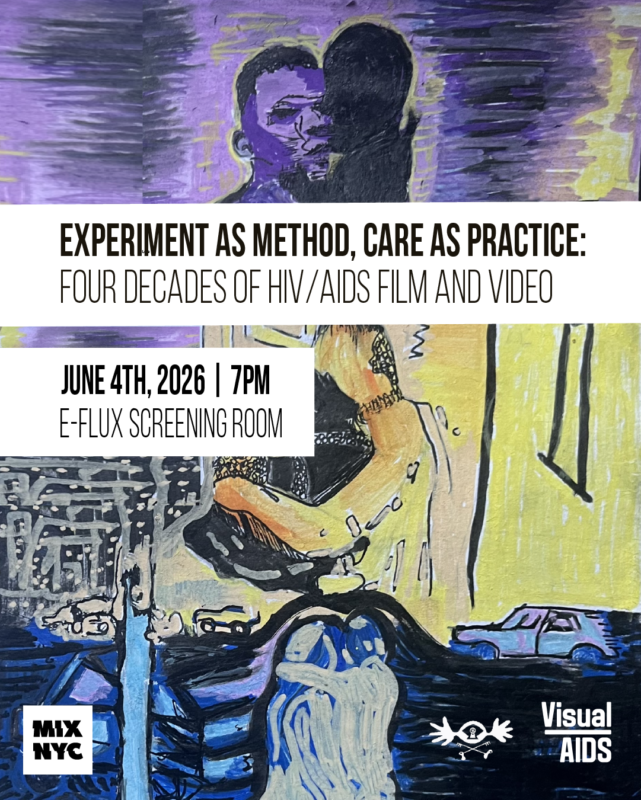


Join Visual AIDS at e-flux Screening Room on Thursday, June 4, 2026, 7-9 pm for Experiment as Method, Care as Practice, Four Decades of HIV/AIDS Film and Video, a program presented in collaboration with The Film-Makers’ Cooperative, Visual AIDS, and MIX NYC, featuring twelve experimental films and videos spanning 1986 to 2024 and sourced from the collections of the three organizations.
For community members who cannot afford a ticket but would like to attend this event, please contact Blake Paskal at bpaskal@visualaids.org.
Tickets available here. Runtime of the program is 100 minutes, followed by a discussion.
The program traces how queer and trans filmmakers have developed new visual languages to render the complexities of life and death with HIV, as the wider community simultaneously formulated ways to survive through it. The provision of care, the insistence on love, the question of pleasure, and the importance of self-documentation in queer life all continue to accrue new meaning and urgency across distinct, ongoing phases of the epidemic.
There are some broad continuities within the works shown here: vehement formal experimentation, a refusal of limitation, the incorporation of spoken word and poetry, and the use of direct testimony alongside elements of documentary practice. Yet at the same time, clear divergences in depicting HIV arise; differing approaches to abstraction and representation, variations in tone and affect, tensions between anonymity and claiming an HIV-positive identity, shifts between individual and collective experience, and the use of analog and digital formats, collage, and other hybrid forms.
By placing these works alongside one another, this selection seeks to both parse and pass beyond persistent representational tropes of life with the virus. It also aims to forge a dialogue between Visual AIDS, The Film-Makers’ Cooperative, and MIX NYC, and to explore how these organizations have incubated and provided alternative spaces for formally and politically rigorous work since the 1980s. This shared experimental visual legacy can be read against the current evolving context of authoritarian governance, cuts to research and medical funding, rising queer and transphobia, racism, and ongoing global inequities in health outcomes.
In this moment of sociopolitical urgency, these audiovisual evocations of resistance, resilience, joy, and subjectivity within HIV-affected communities bring the ancestral archive into dialogue with HIV/AIDS contemporaneity and futurity. Challenging the myth that AIDS is “over,” this program elucidates the multifaceted and intergenerational narrative of the ongoing epidemic, and the ways in which HIV-affected communities have prevailed in spite of serophobic political, medical, and cultural paradigms for over forty years." Is this really matches what the organization provided for us?
Program
Lawrence Brose, An Individual Desires Solution (1986, 16mm-to-digital, color, sound, 16 minutes)
A structural cine-poem concerning death through the struggle for answers and survival of Brose’s boyfriend Kevin, who asked him to redefine AIDS as “An Individual Desires Solution.” Distorted telephone recordings and metaphorical imagery evoke terror, helplessness, and intimacy during the early AIDS crisis.
Cynthia Madansky and Alisa Lebow, Internal Combustion (1995, video, color, sound, 7 minutes)
Internal Combustion breaks the many silences surrounding lesbians and AIDS. Interweaving the voices of two friends, the piece reflects on survival, mourning, power, and loss within the epidemic.
Michelle Handelman, Safer Sexual Techniques in the Age of Mechanical Reproduction (1988, 16mm-to-digital, black-and-white, sound, 10 minutes)
Inspired by structuralist filmmaking, Handelman’s first film offers a surreal impression of safe sex during the AIDS crisis. Constructed across four rolls of 16mm film, it combines in-camera effects, sexual illusion, and manipulated sound into an arcane storybook of risk and desire.
Charles Lum, facts. SUCK (2004, digital, color, sound, 12 minutes)
A short film portraying Charles Lum’s conversations with doctors, nurses, and pharmacists alongside direct-to-camera reflections on desire and self-image. Intensely personal, the film addresses the artist’s ambivalence surrounding sex, discretion, and life as an HIV-positive gay man.
Glen Fogel, 7 Years Later (2014, digital, color, sound, 4 minutes)
Glen Fogel revisits his ex-boyfriend seven years after their breakup, recording a conversation while a robotic camera scans the apartment. Edited to resemble a seamless single take, the film creates an uncanny meditation on intimacy, memory, and time.
Clifford Prince King, Kiss of Life (2022, digital, color, sound, 7 minutes)
In Kiss of Life, four Black people describe their experiences living with HIV. Conversations surrounding disclosure, rejection, and self-love unfold through visual poetry and dreamscapes.
Santiago Lemus and Camilo Acosta Huntertexas, Los Amarillos (2022, digital, color, sound, 10 minutes)
In Colombia, many people living with HIV experience jaundice as a side effect of low-cost antiretroviral drugs supplied by the government. Los Amarillos addresses the alienation and hypervisibility produced by these bodily changes.
Lourdes Portillo, Sometimes My Feet Go Numb (1995, video, black-and-white, sound, 2 minutes)
This black-and-white video poem is a first person account of some of the side effects of living with AIDS and the meds that make living possible.
Juanita Mohammad, Two Men & a Baby (1992, video, color, sound, 7 minutes)
Ray and Tyrone are raising Ray’s nephew Eric, whose mother died of AIDS-related illness. When Eric contracts pneumonia, they discover that he is HIV positive. A poignant story of living with AIDS and family love.
J Triangular and the Women’s Video Support Project, 滴水希望 (Hope Drops) (2021, digital, color, sound, 8.5 minutes)
A collaborative video project made with women living in Taiwan who use their cameras to process stress and stigma, and to share their experiences living with HIV.
Jim Hubbard, Two Marches (1989, 16mm-to-digital, color, sound, 8 minutes)
Scenes from the 1979 and 1987 national gay marches on Washington are juxtaposed to reveal shifts within the gay liberation movement during the AIDS crisis, as hope gives way to mourning, frustration, and political urgency.
Imani Maryahm Harrington, Realms Remix (2024, digital, color, sound, 8.5 minutes)
Through a collage of poetry and archival images, Realms Remix traces memories and sensations of an AIDS past that continue to haunt the present.
The event is co-curated by Blake Paskal and Kyle Croft (Visual AIDS), Lewis McClenaghan (MIX NYC), and Matt McKinzie (The Film-Makers’ Cooperative). Special thanks to Blake Pruitt, Alex Smith, Ariel Ottey, Jac Renée Bruneau (MIX NYC) and Zacarias Gonzalez (The Film-Makers’ Cooperative).
Accessibility
– Two flights of stairs lead up to the building’s front entrance at 172 Classon Avenue.
– For elevator access, please RSVP to program@e-flux.com. The building has a freight elevator nearest to 180 Classon Ave, a garage door, leading into the e-flux office space. A ramp is available for steps within the space.
– e-flux has an ADA-compliant bathroom with no steps between the event space and this bathroom.
Lawrence Brose (1951–2025) was a Buffalo, N.Y.-based experimental filmmaker, photographer, and arts administrator. His films have been shown at international festivals, museums, art galleries, and cinematheques in the United States, Europe, Asia, Australia, and South America. Brose held the position of executive director of CEPA Gallery in Buffalo from 1999 to 2009. In 1989, he began work on FILM for MUSIC for FILM, an ambitious series of collaborations with contemporary composers exploring the relationship between the moving image and music. His 1997 film De Profundis, a 65-minute hand- processed work based on Oscar Wilde's prison letter with an original score by Rzewski, has been screened at more than sixty venues and festivals worldwide. In an artist’s statement, Brose described his work as “cinepoems which build on the vertical layering of experiences rather than a more linear structure familiar to the narrative form.”
Cynthia Madansky’s films integrate hybrid forms and narrative traditions, and engage with cultural and political themes, foregrounding human experience and personal testimony. Recently Madansky has begun integrating drawing on celluloid, creating a series of new works that experiment with optical printing, hand processing and painting.
Alisa Lebow is a documentary filmmaker, scholar, and writer. She holds a doctorate in Cinema Studies from New York University. She currently teaches both undergraduate- and graduate-level courses in film studies at the University of Sussex, UK, and conducts research that explores the intersection of the aesthetic and the political in documentary film and related media. She has written extensively on first person film as a culturally and ideologically imbricated practice of identity production. She is intrigued by the intersection between practice and theory, and her Filming Revolution project, winner of the 2020 SCMS Anne Friedberg Award for Innovative Scholarship, attempts to perform film studies intermedially. Her latest research looks at documentary incursions and interventions in the logics of the Anthropocene.
Michelle Handelman is a visual artist, filmmaker and writer known for her hypnotic, multiscreen cinematic installations that inhabit the dark and uncomfortable spaces of queer desire. Having come up through the years of the AIDS crisis and the Culture Wars, she investigates philosophical questions of existence about the things we collectively fear and deny— sexuality, death, chaos. Handelman’s award-winning film Bloodsisters: Leather, Dykes, and Sadomasochism (1995) is recognized as a landmark in queer film history. Recent projects include Huslters & Empires, commissioned by San Francisco Museum of Modern Art (2018); Irma Vep, The Last Breath, featuring Zackary Drucker (Transparent) and Flawless Sabrina (The Queen); and Beware the Lily Law, a moving image installation on transgender inmates which has been on public view since 2011 at Eastern State Penitentiary, Philadelphia. A Guggenheim Fellow and Creative Capital Awardee, her works have been screened and exhibited widely in the US and internationally.
Jim Hubbard has been making films since 1974. His film United in Anger: A History of ACT UP, a feature-length documentary on the AIDS activist group ACT UP, won Best Documentary at MIX Milano and Reel Q Pittsburgh LGBT Film Festival and has played at over 150 museums, universities and film festivals worldwide. Sarah Schulman and he completed 187 interviews as part of the ACT UP Oral History Project. Hubbard and James Wentzy later created a nine-part cable access television series based on the Project. Among Hubbard’s 19 other films are Elegy in the Streets (1989), The Dance (1992) and Memento Mori (1995). With Sarah Schulman, Hubbard co-founded MIX: The New York Queer Experimental Film Festival. Under the auspices of the Estate Project for Artists with AIDS, he created the AIDS Activist Video Collection at the New York Public Library.
Charles Lum (1958–2021) was a New York-based artist whose work spanned documentary and cinematic narrative, video art, photography, and performance. A 2004 MFA in Photography from the School of the Art Institute of Chicago, Charles was also a career Location Manager and Director’s Guild of America Assistant Director, with 20 years experience scouting and managing feature film and television commercial locations across North America. Lum’s short video collection has been exhibited internationally. Varied in content, most works deal confrontationally with gay sexuality ethics and how the changing realities of HIV affect culture and personal experience. Programmed regularly at prominent queer film festivals, Charles presented work in academic lectures and a variety of art and cinema venues.
Glen Fogel is an artist living and working in New York. Solo exhibitions include Callicoon Fine Arts, New York (2013), Santa Barbara Contemporary Arts Forum (2013), Aspect Ratio, Chicago (2013), Portland Institute of Contemporary Art (2012), Contemporary Arts Museum, Houston (2011), Participant Inc., New York (2011), The Kitchen, New York (2008), and Momenta Art, New York (2006).
Clifford Prince King is an artist living and working in New York and Los Angeles. King documents his intimate relationships in traditional, everyday settings that speak on his experiences as a queer black man. In these instances, communion begins to morph into an offering of memory; it is how he honors and celebrates the reality of layered personhood. Within King's images are nods to the beyond. Shared offerings to the past manifest in codes hidden in plain sight, known only to those who sit within a shared place of knowledge.
Santiago Lemus is an artist born in Sogamoso, Colombia. His interdisciplinary work uses organic matter, image, and sound to address the relationship between art, nature, and landscape through installations, interventions, performances, photography, and video. Lemus’s work has been exhibited in cities such as Bogotá, Barranquilla, and Berlin, among others. He is co-founder of Tomamos la Palabra, a collective that creates interventions in public spaces denouncing homophobia, transphobia, racism and violence.
Camilo Acosta Huntertexas is a visual artist born in Ibagué-Tolima, Colombia with a focus on audiovisual projects, video editing, experimental video, VJ sets, and music video production. His video work has been exhibited in Spain, Germany, Mexico, Canada, and France, among others. He has also developed curatorial projects involving performance, video, and live arts in both conventional and unconventional spaces. Acosta is a co-founder and active member of the House of Tupamaras, a collective committed to research and creative production around issues of gender, performance, and public space. He is also part of the performance collective Street Jizz.
Lourdes Portillo (1943–2024) was born in Chihuahua, Mexico, and raised in Chihuahua, Mexicali and Los Angeles. Portillo made award-winning films about Latin American, Mexican, and Chicano/a experiences and social justice issues for 40 years. Beginning with her first film, After the Earthquake/Despues del Terremoto (1979), she produced and directed over a dozen works that revealed her signature hybrid style as a visual artist, investigative journalist, and activist. Portillo’s 18 completed films include the Academy Award- and Emmy Award-nominated Las Madres:The Mothers of the Plaza de Mayo (1986).
Juanita Mohammed Szczepanski (1957–2022) was a prolific HIV/AIDS videomaker. She produced numerous videos for Gay Men’s Health Crisis’ “Living With AIDS” television program, including the segment Two Men and a Baby. She was the mother of the House of Moshood, part of the ball community. She has spoken and volunteered at community group venues, LGBT community centers, public libraries, museums and schools. Following her retirement from New York City Human Resources as a HIV/AIDS caseworker, her production company Diversity Video Productions, run with her husband Henry Szczepanski, produced videos on issues dealing with AIDS, homelessness, disability, and youth.
J Triangular is an independent curator, experimental filmmaker, and multimedia poet. Colombia-born, Taiwan-based, J graduated in film studies and screenwriting at TAI University School of Arts, Madrid, Spain. He received his master's degree in experimental documentary at the Cinema and Audiovisual School of Catalonia, Spain. His work consistently addresses themes such as community identity, self-empowerment, care practices, and promoting communication and solidarity. In 2019, J was the international curator in residence at Visual AIDS with his project The Whole World is Watching which has been exhibited internationally in Taipei, Tokyo, Kyoto, Tlaxcala, Mexico City, Lima, and Colombia.
Imani Maryahm Harrington is a writer, author and conceptual artist who has documented on the conditions of women since the age of 25. She was an editor for the anthology Positive/Negative: Women of Color and HIV/AIDS: A Collection of Plays (2002) and her play Love & Danger (1995) was among the first to address women and HIV. Her other titles include The Communal Plays and Other Narratives, On Writing I, ISSHOWAT, and House of Leaven.
Related Projects

Related Artists
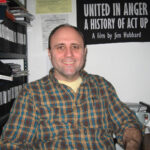
Jim Hubbard

Charles Lum
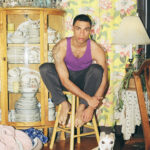
Clifford Prince King
Santiago Lemus
Camilo Huntertexas
IMH